



(English Below)
Durante décadas, ser un fanático del metal extremo significaba vivir en los márgenes culturales. Éramos los habitantes de las trincheras, los que intercambiábamos cintas de cassette con portadas fotocopiadas, los que entendíamos una estética y una sonoridad que el mainstream no solo rechazaba, sino que activamente temía. La cultura pop (el cine de Hollywood, las series de horario estelar, los videojuegos superventas) era el enemigo, un monolito de complacencia sónica contra el que nuestras bandas favoritas lanzaban sus cócteles molotov de distorsión.
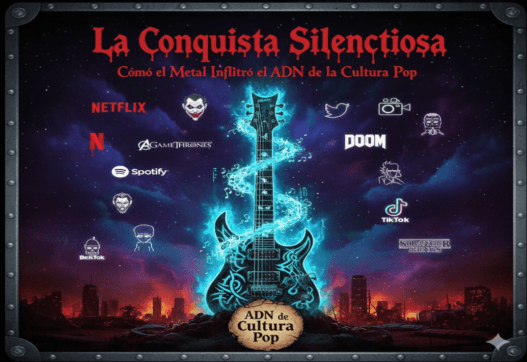
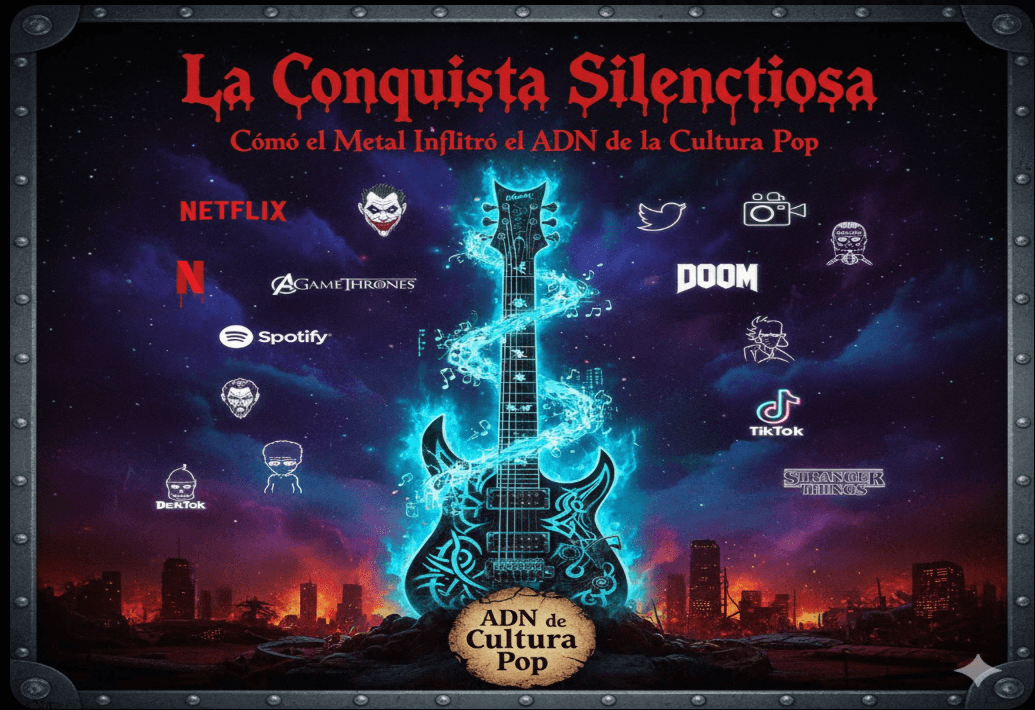
Sin embargo, algo cambió en el camino hacia el siglo XXI. Como un virus persistente o una línea de bajo de Black Sabbath, el metal comenzó a filtrarse por las grietas de la cultura de masas. Ya no como el villano de la película o el chiste fácil del «melenudo tonto», sino como una fuerza estética y narrativa poderosa.
Hoy, desde mi perspectiva y consumidor voraz de esta música, veo una realidad fascinante: el metal se ha convertido en el lenguaje universal de la intensidad en la cultura pop. Cuando un director de cine, un diseñador de videojuegos o un guionista necesita inyectar adrenalina pura, rebelión visceral o una atmósfera de horror cósmico, ya no recurren a una orquesta sinfónica; recurren al riff.
En este artículo, diseccionamos cómo nuestro amado ruido ha pasado de ser un paria social a una herramienta cultural indispensable, analizando datos, hitos clave y esa extraña sensación de victoria (y a veces, de ligera traición) que sentimos cuando nuestra música suena donde menos la esperamos.
I. El Cine: Del pánico satánico al recurso narrativo
La relación del cine con el metal comenzó siendo, previsiblemente, conflictiva. Durante los 80, el metalero en pantalla era casi siempre un delincuente drogadicto o un siervo de Satanás, un reflejo directo del «Satanic Panic» que azotaba Estados Unidos. La música se usaba para marcar al «otro», al peligroso.
- El punto de inflexión: La comedia y el horror
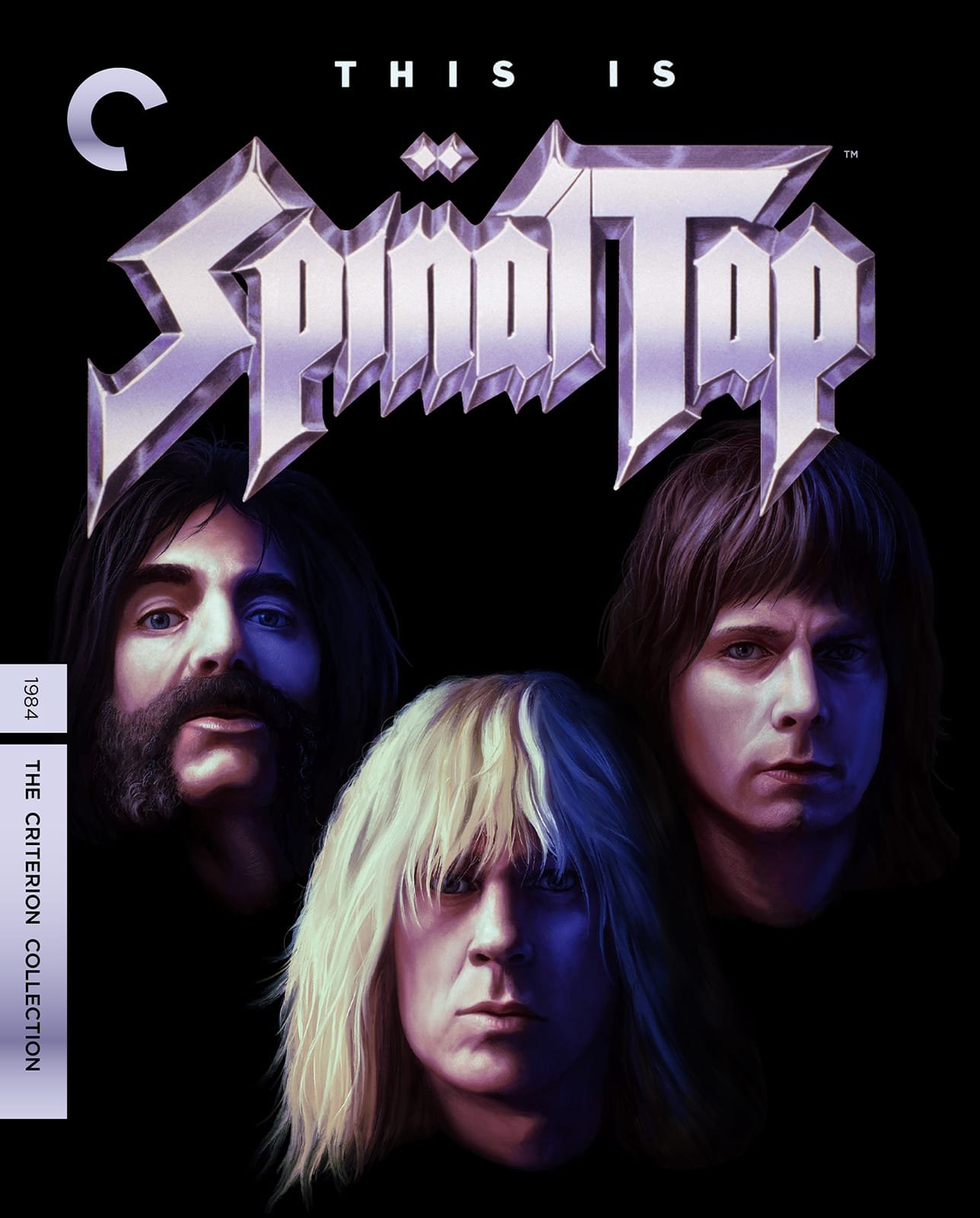
Paradójicamente, fue la comedia la que empezó a humanizar al género. El falso documental «This Is Spinal Tap» (1984), aunque una sátira brutal, fue hecha con un amor genuino por los excesos del hard rock y el heavy metal. Nos reíamos con ellos, no solo de ellos.
Pero el momento que rompió la Matrix para los fans del metal extremo ocurrió en 1994, en una comedia familiar: «Ace Ventura: Pet Detective». La aparición de Cannibal Corpse (anunciados en la película como «Thrashed») tocando «Hammer Smashed Face» en un club mientras Jim Carrey hace crowdsurfing sigue siendo surrealista. Por unos segundos, el brutal death metal de Tampa, Florida, fue consumido por millones de familias en todo el mundo. No fue un chiste a costa de la banda; fue una celebración de su extremismo sónico como parte del paisaje urbano.
- La sinergia natural con el terror
El cine de terror siempre ha sido el aliado natural del metal. Ambos tratan con lo macabro, la muerte y la transgresión. Sin embargo, hemos pasado de usar el metal como simple música de fondo a integrarlo en la trama.
Películas como «Deathgasm»(2015) son cartas de amor al black y death metal, llenas de referencias internas que solo nosotros entendemos (desde la pintura facial estilo King Diamond hasta bromas sobre la ilegibilidad de los logos). Aquí, el metal es el protagonista, el héroe improbable contra el mal banal.
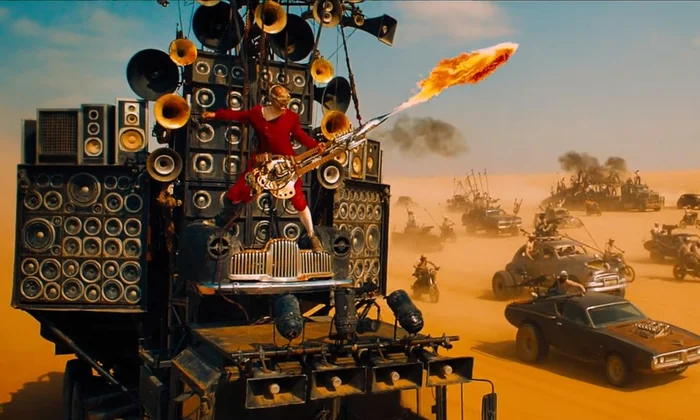
En el cine de acción moderno, el metal se usa para codificar la violencia estilizada. Pensemos en «Mad Max: Fury Road» (2015). El personaje del «Doof Warrior», colgado de un camión a toda velocidad tocando una guitarra lanzallamas, es la encarnación visual más perfecta del espíritu del heavy metal jamás filmada. No necesita diálogo; el riff es su lenguaje y la distorsión su arma. Es una imagen que ningún fan del género olvidará jamás.
II. Las series y el «Efecto Munson»: Un terremoto de datos
La televisión tardó más en aceptar el metal, relegándolo a menudo a camisetas mal llevadas por personajes secundarios en sitcoms como «Friends». Pero la animación para adultos abrió la puerta.
- De Beavis and Butt-Head a Metalocalypse
MTV, en su época dorada, nos dio «Beavis and Butt-Head». A pesar de su estupidez, sus comentarios sobre videos de Morbid Angel, Death o GWAR validaron a una generación de adolescentes que se sentían representados en esa apatía suburbana rota solo por la música agresiva.
Más tarde, Adult Swim nos trajo la obra maestra de la sátira interna: «Metalocalypse»(2006-2013). Creada por Brendon Small (un músico extremadamente competente), la serie sigue a Dethklok, una banda de melodic death metal tan exitosa que es la séptima economía mundial. «Metalocalypse» es brillante porque entiende los tropos del metal extremo (la brutalidad lírica, la obsesión por el equipo, la pose «trve») y los exagera hasta el absurdo con un cariño inmenso. La música, además, era legítimamente buena, con álbumes de Dethklok entrando en las listas de Billboard.
- Stranger Things y la «resurrección» de Metallica
Sin embargo, ningún evento en la historia reciente ha tenido el impacto medible de la cuarta temporada de «Stranger Things» (2022). La introducción del personaje de Eddie Munson, un dungeon master metalero marginado en los 80, tocó una fibra sensible. Eddie no era el villano; era el héroe incomprendido.
La escena cumbre, donde Eddie toca «Master of Puppets» de Metallica en el «Upside Down» para atraer a unos demonios murciélago, fue un fenómeno cultural. No fue solo una sincronización musical; fue el metal usado como arma mágica, como escudo protector.
Los datos son asombrosos:
En las semanas posteriores al estreno, las reproducciones de «Master of Puppets» en Spotify aumentaron un 400%.
La canción, lanzada en 1986, entró por primera vez en el Top 40 del Reino Unido y en el Billboard Hot 100 de EE.UU.
Metallica reportó un aumento masivo en la venta de merchandising a un grupo demográfico completamente nuevo: adolescentes que ni siquiera habían nacido cuando se editó St. Anger, y mucho menos el Master.
Este evento demostró a los ejecutivos de la industria que el metal clásico tiene un poder de permanencia y una capacidad de conectar con la «Generación Z» que pocos géneros poseen.
III. Videojuegos: La simbiosis perfecta y la revolución sonora
Si el cine coquetea con el metal y la TV lo usa como recurso narrativo, los videojuegos son su hogar espiritual. La interactividad del medio y la necesidad de mantener la adrenalina del jugador durante horas hacen del metal la banda sonora perfecta. La conexión es fundacional.
- El legado de DOOM
En 1993, DOOM cambió el mundo. Su compositor, Bobby Prince, era un abogado que se pasó a la música. Cuando Id Software le pidió la música para su shooter de demonios en Marte, Prince «tomó prestados» (en un área legalmente gris) riffs de Pantera, Slayer y Metallica, traduciéndolos a formato MIDI. El tema «E1M1 (At Doom’s Gate)» es básicamente una versión acelerada de «No Remorse» de Metallica mezclada con la actitud de Pantera. Para millones de jugadores, esa fue su introducción inconsciente al thrash y al groove metal.
- La revolución de Mick Gordon
El reinicio de DOOM (2016) y su secuela DOOM Eternal (2020) llevaron esto a un nivel estratosférico. El compositor Mick Gordon no quiso simplemente hacer «metal para videojuegos»; quiso redefinir cómo suena la violencia digital.
Gordon utilizó guitarras de 7 y 8 cuerdas afinadas en registros abismales y, crucialmente, trató la señal de la guitarra no como un instrumento acústico, sino como una fuente de sonido pura para ser manipulada por sintetizadores modulares antiguos y cadenas de pedales de distorsión extremas. El resultado es un híbrido de djent, metal industrial y glitch que suena como una motosierra biomecánica.
La banda sonora de DOOM Eternal es dinámica. El motor del juego mezcla las capas de música en tiempo real según la intensidad del combate. Si solo estás explorando, escuchas un ambiente tenso; si entras en combate con un «Glory Kill», el motor libera los riffs más pesados y el doble bombo. El jugador, con sus acciones, dirige la banda sonora de metal.
- El Metal como mecánica de juego
La integración ha llegado al punto en que el metal ya no es solo fondo, sino la mecánica principal.
Brütal Legend (2009): Un juego creado por Tim Schafer y protagonizado por Jack Black que es una enciclopedia jugable del heavy metal. El mundo es una portada de disco de los 80 cobrada vida, y cuenta con las voces de Lemmy Kilmister, Rob Halford y Ozzy Osbourne. Es un museo interactivo de nuestra cultura.
Metal: Hellsinger (2022): Un rhythm shooter donde debes disparar al compás del doble bombo y los riffs. Cuanto más preciso eres, más intensa se vuelve la música y más daño haces. La banda sonora cuenta con vocalistas de Arch Enemy, Dark Tranquillity y Lamb of God. Aquí, si no sientes el ritmo del metal, simplemente no puedes jugar bien. El jugador se convierte en parte de la banda.
IV. Conclusión: La victoria de la autenticidad sobre la asimilación
Al repasar esta trayectoria, desde los márgenes hasta el centro de la cultura pop, surge una pregunta incómoda entre los puristas del metal extremo: ¿Se ha diluido nuestra cultura al volverse accesible? ¿Ha perdido su filo el Black Metal ahora que su estética aparece en videojuegos mainstream o que celebridades usan camisetas de bandas que no escuchan?
Mi conclusión es rotunda: No.
La exposición mainstream no diluye el metal extremo; simplemente crea nuevas puertas de entrada. El chico de 15 años que descubrió a Metallica por Stranger Things hoy, puede estar descubriendo a Slayer mañana, y quizás en un año esté buceando en la discografía de Cannibal Corpse o Emperor porque la intensidad del videojuego DOOM le despertó un hambre por sonidos más extremos.
El metal ha triunfado en la cultura pop porque ofrece algo que el pop prefabricado no puede: una catarsis auténtica, una complejidad técnica y una imaginería poderosa que resuena con los aspectos más oscuros y vibrantes de la experiencia humana. Hollywood y la industria del videojuego han aprendido que, cuando necesitan invocar el poder puro, no hay sustituto para un amplificador al 11 y un buen riff de guitarra. Hemos ganado la guerra cultural, y lo hemos hecho sin bajar el volumen.
For decades, being an extreme metal fan meant living on the cultural fringes. We were the inhabitants of the trenches, those of us who traded cassette tapes with photocopied covers, who understood an aesthetic and a sonority that the mainstream not only rejected but actively feared. Pop culture Hollywood cinema, prime-time series, blockbuster video games was the enemy, a monolith of sonic complacency against which our favorite bands threw their Molotov cocktails of distortion.
However, something changed on the road to the 21st century. Like a persistent virus or a Black Sabbath bass line, metal began to seep through the cracks of mass culture. No longer as the movie villain or the easy joke of the «dumb long-hair,» but as a powerful aesthetic and narrative force.
Today, from my perspective as a voracious consumer of this music, I see a fascinating reality: metal has become the universal language of intensity in pop culture. When a film director, a video game designer, or a screenwriter needs to inject pure adrenaline, visceral rebellion, or an atmosphere of cosmic horror, they no longer turn to a symphonic orchestra; they turn to the riff.
In this article, we dissect how our beloved noise has gone from being a social pariah to an indispensable cultural tool, analyzing data, key milestones, and that strange feeling of victory (and sometimes, of slight betrayal) that we feel when our music plays where we least expect it.
I. Cinema: From satanic panic to narrative resource
Cinema’s relationship with metal began by being, predictably, conflictive. During the 80s, the metalhead on screen was almost always a drug-addicted delinquent or a servant of Satan—a direct reflection of the «Satanic Panic» sweeping the United States. The music was used to mark the «other,» the dangerous one.
- The turning point: Comedy and horror
Paradoxically, it was comedy that began to humanize the genre. The mockumentary «This Is Spinal Tap» (1984), although a brutal satire, was made with a genuine love for the excesses of hard rock and heavy metal. We laughed with them, not just at them.
But the moment that broke the Matrix for extreme metal fans occurred in 1994, in a family comedy: «Ace Ventura: Pet Detective». The appearance of Cannibal Corpse (announced in the film as «Thrashed») playing «Hammer Smashed Face» in a club while Jim Carrey is crowdsurfing remains surreal. For a few seconds, the brutal death metal of Tampa, Florida, was consumed by millions of families worldwide. It wasn’t a joke at the band’s expense; it was a celebration of their sonic extremism as part of the urban landscape.
- The natural synergy with horror
Horror cinema has always been the natural ally of metal. Both deal with the macabre, death, and transgression. However, we have moved from using metal as simple background music to integrating it into the plot.
Films like «Deathgasm» (2015) are love letters to black and death metal, full of internal references that only we understand (from King Diamond-style face paint to jokes about the illegibility of logos). Here, metal is the protagonist, the unlikely hero against banal evil.
In modern action cinema, metal is used to encode stylized violence. Think of «Mad Max: Fury Road» (2015). The character of the «Doof Warrior,» hanging from a speeding truck playing a flamethrower guitar, is the most perfect visual embodiment of the heavy metal spirit ever filmed. He needs no dialogue; the riff is his language and distortion is his weapon. It is an image that no fan of the genre will ever forget.
II. Series and the «Munson Effect»: A data earthquake
Television took longer to accept metal, often relegating it to poorly worn t-shirts by secondary characters in sitcoms like «Friends». But adult animation opened the door.
- From Beavis and Butt-Head to Metalocalypse
MTV, in its golden age, gave us «Beavis and Butt-Head». Despite their stupidity, their comments on videos by Morbid Angel, Death, or GWAR validated a generation of teenagers who felt represented in that suburban apathy broken only by aggressive music.
Later, Adult Swim brought us the masterpiece of internal satire: «Metalocalypse» (2006-2013). Created by Brendon Small (an extremely competent musician), the series follows Dethklok, a melodic death metal band so successful it is the world’s seventh-largest economy. «Metalocalypse» is brilliant because it understands the tropes of extreme metal (lyrical brutality, obsession with gear, the «trve» pose) and exaggerates them to the point of absurdity with immense affection. The music, moreover, was legitimately good, with Dethklok albums entering the Billboard charts.
- Stranger Things and the «Resurrection» of Metallica
However, no event in recent history has had the measurable impact of the fourth season of «Stranger Things» (2022). The introduction of the character of Eddie Munson, a marginalized metalhead dungeon master in the 80s, struck a chord. Eddie was not the villain; he was the misunderstood hero.
The climactic scene, where Eddie plays Metallica’s «Master of Puppets» in the «Upside Down» to lure bat-demons, was a cultural phenomenon. It wasn’t just a musical sync; it was metal used as a magical weapon, as a protective shield.
The data is staggering:
In the weeks following the premiere, streams of «Master of Puppets» on Spotify increased by 400%.
The song, released in 1986, entered the UK Top 40 and the US Billboard Hot 100 for the first time.
Metallica reported a massive increase in merch sales to a completely new demographic: teenagers who weren’t even born when St. Anger was released, let alone Master.
This event proved to industry executives that classic metal has a staying power and a capacity to connect with «Gen Z» that few genres possess.
III. Video games: The perfect symbiosis and the sonic revolution
If cinema flirts with metal and TV uses it as a narrative resource, video games are its spiritual home. The interactivity of the medium and the need to maintain the player’s adrenaline for hours make metal the perfect soundtrack. The connection is foundational.
- The legacy of DOOM
In 1993, DOOM changed the world. Its composer, Bobby Prince, was a lawyer-turned-musician. When Id Software asked him for the music for their demon-shooter on Mars, Prince «borrowed» (in a legally gray area) riffs from Pantera, Slayer, and Metallica, translating them into MIDI format. The track «E1M1 (At Doom’s Gate)» is basically a sped-up version of Metallica‘s «No Remorse» mixed with Pantera‘s attitude. For millions of players, that was their unconscious introduction to thrash and groove metal.
- The Mick Gordon revolution
The reboot of DOOM (2016) and its sequel DOOM Eternal (2020) took this to a stratospheric level. Composer Mick Gordon didn’t just want to make «video game metal»; he wanted to redefine how digital violence sounds.
Gordon used 7 and 8-string guitars tuned to abyssal registers and, crucially, treated the guitar signal not as an acoustic instrument, but as a pure sound source to be manipulated by vintage modular synthesizers and extreme distortion pedal chains. The result is a hybrid of djent, industrial metal, and glitch that sounds like a biomechanical chainsaw.
The DOOM Eternal soundtrack is dynamic. The game engine mixes the music layers in real-time according to the intensity of the combat. If you are just exploring, you hear a tense ambient; if you enter combat with a «Glory Kill», the engine releases the heaviest riffs and double bass drumming. The player, through their actions, conducts the metal soundtrack.
- Metal as game mechanics
Integration has reached the point where metal is no longer just background, but the primary mechanic.
Brütal Legend (2009): A game created by Tim Schafer and starring Jack Black that is a playable encyclopedia of heavy metal. The world is an 80s album cover come to life, and it features the voices of Lemmy Kilmister, Rob Halford, and Ozzy Osbourne. It is an interactive museum of our culture.
Metal: Hellsinger (2022): A rhythm shooter where you must shoot to the beat of the double bass and riffs. The more precise you are, the more intense the music becomes and the more damage you deal. The soundtrack features vocalists from Arch Enemy, Dark Tranquillity, and Lamb of God. Here, if you don’t feel the rhythm of the metal, you simply cannot play well. The player becomes part of the band.
IV. Conclusion: The Victory of Authenticity over Assimilation
When reviewing this trajectory, from the margins to the center of pop culture, an uncomfortable question arises among extreme metal purists: Has our culture been diluted by becoming accessible? Has Black Metal lost its edge now that its aesthetic appears in mainstream video games or that celebrities wear t-shirts of bands they don’t listen to?
My conclusion is emphatic: No.
Mainstream exposure does not dilute extreme metal; it simply creates new entry points. The 15-year-old kid who discovered Metallica through «Stranger Things» today might be discovering Slayer tomorrow, and perhaps in a year, they will be diving into the discography of Cannibal Corpse or Emperor because the intensity of the game DOOM awakened a hunger for more extreme sounds.
Metal has triumphed in pop culture because it offers something that prefabricated pop cannot: authentic catharsis, technical complexity, and powerful imagery that resonates with the darkest and most vibrant aspects of the human experience. Hollywood and the video game industry have learned that when they need to invoke pure power, there is no substitute for an amp turned to 11 and a good guitar riff. We have won the cultural war, and we have done it without lowering the volume.