




(English Below)
Llevo más de treinta años metido en las entrañas de esta escena, viendo cómo el metal extremo pasaba de ser un secreto de Estado en casetes mal grabadas a convertirse en una exhibición de virtuosismo en alta definición. He visto caer imperios discográficos, he visto mutar los géneros y, sobre todo, he visto cómo cambiaba la forma de tocar. A principios de los noventa, cuando caía en tus manos un disco de Technical Death Metal, sabías que ibas a escuchar algo peligroso, algo que desafiaba las leyes de la música pero que mantenía los pies en el foso. Hoy, en pleno 2026, abro cualquier red social o plataforma de streaming y me encuentro con chavales de dieciséis años tocando a 280 BPM con una ejecución limpia, milimétrica, robótica. Una perfección impecable desde el dormitorio de su casa.
Pero cuando termina el vídeo de treinta segundos, me hago la misma pregunta que me lleva rondando la cabeza los últimos cinco años: ¿Dónde demonios están las canciones?
Bienvenidos a Atanathos. Hoy no vengo a morderos la lengua ni a regalaros los oídos. Vengo a plantear una crítica frontal y descarnada contra la deriva de nuestra escena. Vamos a analizar la obsolescencia del virtuosismo y cómo la «atletización» del metal extremo está asesinando la composición, el peligro y la atmósfera que un día hicieron grande a este género.
Para entender cómo hemos llegado a este punto de saturación técnica en 2026, tenemos que bajarnos de la tarima del conservatorio y mirar al foso. El metal extremo nació como una música de ruptura, un puñetazo en la mesa frente a las estructuras comerciales. El objetivo era transmitir horror, caos, alienación, velocidad o pesadez existencial. La técnica era el vehículo, no el destino. Hoy, desgraciadamente, los papeles se han invertido: la canción es solo la excusa para justificar un ejercicio gimnástico de mástil.
I. La era de la Atletización: El metrónomo como dictador
En la última década, el metal extremo -especialmente subgéneros como el Technical Death Metal, el Modern Deathcore y el Prog-Metal- ha sufrido un proceso que en Atanathos denominamos atletización. La música ya no se mide en términos de peso emocional, dinamismo o atmósfera, sino en parámetros puramente cuantitativos: ¿A cuántos BPM puedes meter blast beats? ¿Cuántas notas por segundo tiene tu solo en sweep picking? ¿Cuántas cuerdas tiene tu guitarra?
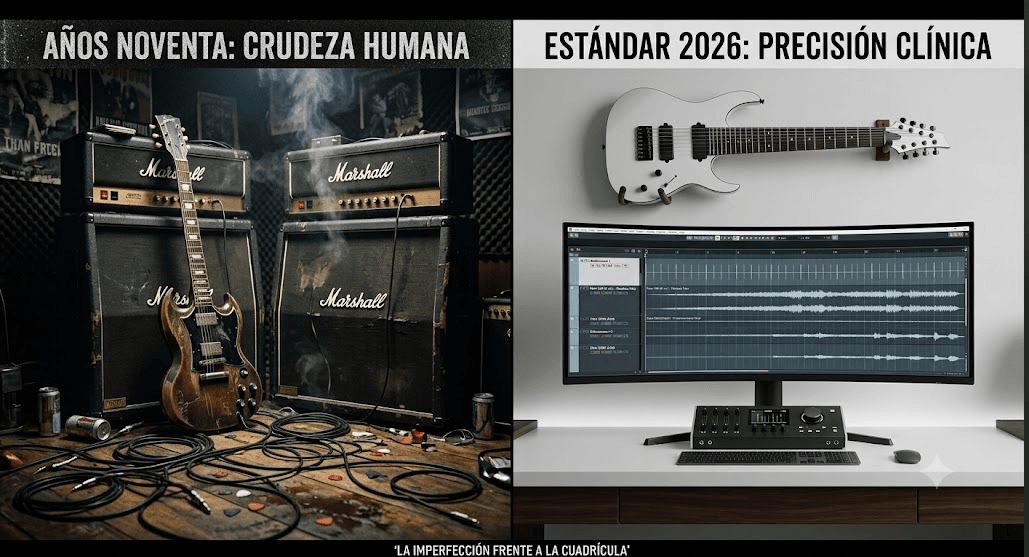
La tecnología ha democratizado el acceso al instrumento, lo cual es fantástico, pero también ha creado una burbuja artificial. En los noventa, para que la gente escuchara tus riffs, tenías que meterte en un local de ensayo, convencer a otros cuatro locos, sudar sangre, dar conciertos en salas de mala muerte y grabar una maqueta. Aprendías a componer interactuando con otros seres humanos y chocando contra el sonido real de la sala.
Hoy, en 2026, un guitarrista puede pasarse cinco años encerrado en su habitación tocando sobre una pista de batería programada. El software de edición actual permite cuantizar cada nota, limpiar los errores de ejecución y editar la velocidad de un plumazo. El resultado es un producto diseñado para el consumo rápido en redes: vídeos de quince segundos donde se muestra el pasaje más difícil del tema. El problema es que un buen truco de circo de quince segundos no sostiene un álbum de cuarenta y cinco minutos.
II. Los Años 90 frente a 2026: Cuando la técnica servía al horror
Mucha gente de las nuevas generaciones me dice: «Pero viejo, en los noventa ya había bandas ultra-técnicas». Por supuesto que las había. La diferencia radical estriba en cómo utilizaban ese virtuosismo. Pensemos en los tres pilares del Death Metal técnico de aquella década: Death, Suffocation y Cryptopsy.
1. Chuck Schuldiner (Death) y la línea narrativa
Cuando escuchas un disco como «Individual Thought Patterns» (1993) o «Symbolic» (1995), te encuentras con músicos de un nivel estratosférico (Gene Hoglan, Andy LaRocque, Steve DiGiorgio). Los riffs de Chuck Schuldiner eran complejos, usaban escalas exóticas y estructuras progresivas. Sin embargo, cada solo de Chuck tenía una línea narrativa. Podías tararear el solo. La técnica estaba ahí para elevar la carga lírica y filosófica de las canciones. Schuldiner entendía que el silencio y el contraste daban fuerza al impacto.
2. Suffocation y la invención del peso
Con «Effigy of the Forgotten» (1991) o «Pierced from Within» (1995), Terrance Hobbs y Guy Marchais llevaron la complejidad rítmica a otro nivel. Inventaron estructuras que rompían la métrica tradicional, pero lo hacían para crear una sensación de asfixia y violencia estructural. No era un ejercicio de velocidad estéril; era una demolición arquitectónica donde cada cambio de tiempo te golpeaba en el pecho.
3. Cryptopsy y el caos orgánico
«None So Vile» (1996) es probablemente uno de los discos más rápidos y técnicos de la historia del metal extremo. Flo Mounier a la batería y Jon Levasseur a la guitarra tocaban al límite de lo físicamente posible en su época. Pero el disco suena peligroso, sucio, animal. Escuchas las cuerdas trastear, escuchas la batería respirar. Hay un peligro real de que la música descarrile en cualquier momento, y ese peligro es precisamente lo que genera la adrenalina.
La Comparativa con el Tech-Death de 2026
Si ponemos esos clásicos al lado de la media del Technical Death Metal actual, la diferencia es dolorosa. Las producciones modernas son tan perfectas que resultan estériles. Las baterías suenan completamente disparadas (suplantadas por samples digitales), eliminando cualquier rastro de la dinámica del golpe humano. Las guitarras están grabadas directamente por línea y procesadas con emuladores digitales que limpian tanto el sonido que le quitan el crujido, el sudor y la mugre. Se toca más rápido que nunca, sí, pero se transmite menos que nunca.
III. Análisis psicoacústico: Shredding gimnástico vs. Atmósfera
Para entender por qué un solo hiperveloz moderno puede llegar a aburrir a los cinco minutos mientras que un riff de tres notas de Doom o de Black Metal te puede cambiar la vida, tenemos que recurrir a la psicoacústica. El cerebro humano se cansa rápidamente de la saturación de información plana.
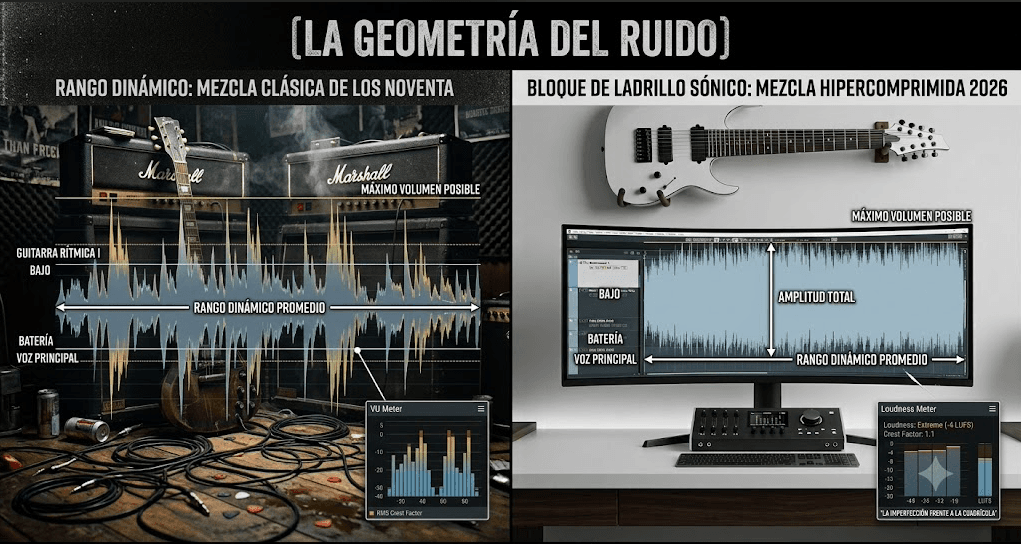
Cuando una guitarra ejecuta pasajes a base de semicorcheas o fusas a 260 BPM de manera ininterrumpida, la onda sónica se convierte, a ojos de nuestro sistema auditivo, en una línea continua. Al no haber picos de dinámica -al estar todo comprimido al mismo volumen y a la misma velocidad-, el cerebro desconecta. Deja de percibir la velocidad como algo «rápido» y pasa a procesarla como ruido blanco.
El verdadero sentido de la velocidad solo existe cuando se contrasta con la lentitud. Si todo es rápido, nada es rápido.
Era de los 90 (Dinamismo):
[Riff Pesado / Lento] ---> [Aceleración Súbita] ---> [Clímax Técnico] = Impacto Emocional

Era de 2026 (Saturación):
[Velocidad Máxima] ---> [Velocidad Máxima] ---> [Velocidad Máxima] = Fatiga Auditiva
Pensemos en Trey Azagthoth de Morbid Angel. Sus solos en discos como «Blessed Are the Sick» (1991) o «Covenant» (1993) no eran limpios. Eran ruidosos, llenos de efectos de whammy, disonancias y texturas que imitaban el fluir de la lava o el grito de demonios sumerios. Azagthoth no buscaba que dijeras «qué bien ejecuta la escala mayor»; buscaba que sintieras miedo.
Lo mismo ocurre con Incantation o, en la escena más moderna, con Ulcerate o Dead Congregation. Estas bandas utilizan la técnica para construir una catedral de opresión. Las notas se arrastran, se superponen, chocan entre sí creando armónicos naturales que ensucian la mezcla de forma consciente. Hay un uso inteligente del espacio y de la reverberación. Eso es crear atmósfera. El shredding gimnástico, por el contrario, es bidimensional: empieza y termina en los dedos del músico.
IV. El síndrome del «Músico para Músicos»
Uno de los mayores peligros que he detectado desde mi posición en Atanathos es que el metal extremo ultra-técnico ha dejado de hablarle al fan para hablarle exclusivamente a otros músicos. Se ha convertido en una disciplina endogámica.
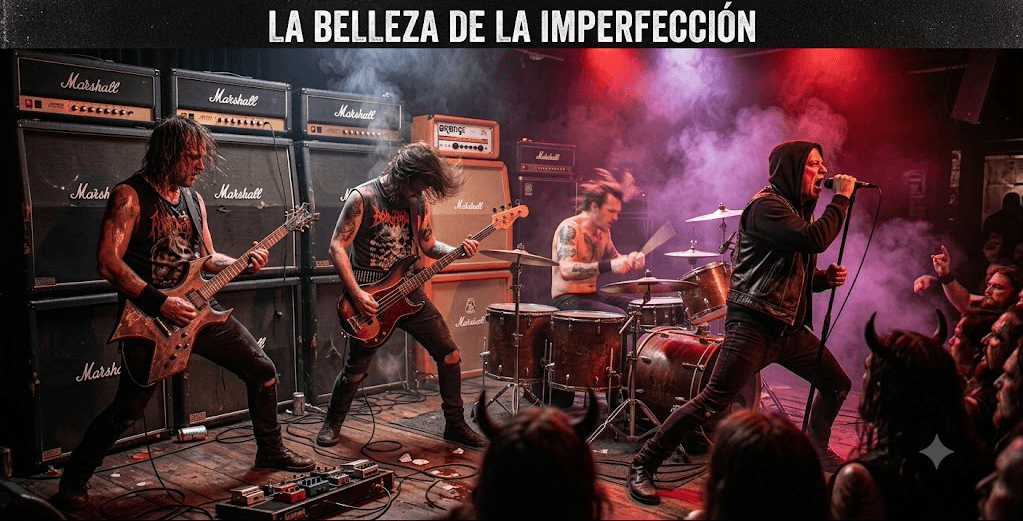
Cuando vas a un concierto de ciertas bandas de la escena técnica actual, el público ya no hace mosh ni se desgañita la garganta. La gente está parada, con los brazos cruzados, mirando fijamente el diapasón del guitarrista para ver si mete una nota falsa o analizando la técnica de pies del batería. Se ha perdido el componente ritual, la catarsis colectiva del concierto de metal. Se ha sustituido la pasión por la auditoría.
¿Se puede ser demasiado bueno tocando y demasiado malo transmitiendo? Rotundamente sí. La historia de la música está llena de virtuosos olvidados y de compositores limitados técnicamente que cambiaron el mundo. En el metal extremo, la obsesión por no repetir patrones y por meter la mayor cantidad de cambios de tiempo posibles ha destruido el concepto de estructura.
Muchas canciones actuales parecen una lista de reproducción de ejercicios de conservación:
Riff de introducción en tapping a dos manos.
Transición con polirritmia de batería 7/8 sobre 4/4.
Solo de guitarra con escalas disminuidas a toda pastilla.
Breakdown ultra-sincopado con afinación en Drop Z.
Al terminar el tema, eres incapaz de recordar una sola melodía, un solo gancho rítmico, una sola frase que te mueva las entrañas. La música se ha vuelto predecible dentro de su propia complejidad. Se ha estandarizado el caos.
V. Cuadro analítico: La evolución de los valores en el Metal Extremo
Para sintetizar esta transformación de tres décadas, he elaborado este cuadro que refleja cómo los objetivos prioritarios de las bandas han basculado desde los elementos artísticos hacia los deportivos:
| Parámetro Artístico | La Escuela Clásica (Años 90) | La Escuela de Dormitorio (2026) |
| Objetivo Principal | Crear una atmósfera de peligro, horror o pesadez. | Demostrar la máxima velocidad y limpieza técnica posible. |
| Producción de Audio | Orgánica, analógica, con margen para el error y la dinámica. | Hiper-procesada, cuantizada, editada nota por nota en ordenador. |
| Relación con el Público | Catarsis física, comunión en el foso, energía bruta. | Admiración técnica, consumo en vídeos cortos, análisis de equipo. |
| Composición | Basada en el riff, la estructura narrativa y el contraste. | Basada en la acumulación de secciones complejas y pasajes de lucimiento. |
| El Error de Ejecución | Se integraba como parte de la honestidad y agresividad del directo. | Se elimina sistemáticamente mediante software de corrección. |
VI. El resurgimiento orgánico: La resistencia en 2026
Por suerte, no todo está perdido en 2026. Como siempre ocurre en el arte, a toda acción le sigue una reacción. La saturación de bandas robóticas ha provocado un resurgimiento brutal de la escena que abraza lo rancio, lo sucio y lo analógico. Es lo que en las páginas de Atanathos defendemos como el Retorno a la Caverna.
Bandas contemporáneas como Blood Incantation, Tomb Mold, Cruciamentum o los neozelandeses Ulcerate han demostrado que se puede poseer un nivel técnico excelso pero poniéndolo al servicio de la composición y la oscuridad.
El Caso de Blood Incantation con «Starspawn» (2016) y sus lanzamientos posteriores son el ejemplo perfecto de cómo romper esta maldición del virtuosismo estéril. Los tíos tocan de miedo, tienen pasajes progresivos larguísimos y estructuras complejas. Pero graban en cinta analógica, ensayan juntos en una habitación hasta que las canciones sangran, y permiten que las guitarras respiren, que haya acoples y que la batería se mueva de tempo si la intensidad del tema lo requiere. Escuchas su música y sientes la inmensidad del horror cósmico, no la pantalla de un ordenador de edición.
Conclusión: Menos dedos, más tripas
No me malinterpretéis: no tengo nada en contra de que los músicos estudien y alcancen niveles técnicos de infarto. Al contrario, el metal extremo siempre ha sido una música que ha empujado los límites de lo físicamente realizable en un instrumento. El problema surge cuando confundimos la herramienta con la obra de arte.
La técnica sin composición es solo gimnasia. Un catálogo de acordes perfectos ejecutados a velocidades de vértigo no vale nada si no es capaz de evocar el vacío, la rabia, la desesperación o la muerte. El metal extremo no nació en las academias de música; nació de la necesidad de expresar las zonas más oscuras del alma humana. Y el alma es imperfecta, es ruidosa, es caótica.
A todos los jóvenes guitarristas, bajistas y baterías que nos leéis desde vuestros dormitorios en 2026 os digo: apagad el metrónomo durante una tarde. Bajadle el volumen a la limpieza digital. Buscad a otros tres colgados, meteos en un sótano, subid la ganancia de los amplificadores hasta que vibren los cristales y tocad algo que os duela en las tripas, no en las muñecas. La escena no necesita más atletas; necesita más compositores que vuelvan a encender el fuego del peligro real.
I have been deep in the guts of this scene for over thirty years, watching extreme metal go from being a state secret on badly recorded cassettes to becoming a high-definition exhibition of virtuosity. I have seen record label empires fall, I have seen genres mutate, and above all, I have seen how the way of playing has changed. In the early nineties, when a Technical Death Metal album fell into your hands, you knew you were going to hear something dangerous something that defied the laws of music but kept its feet in the pit. Today, in the middle of 2026, I open any social network or streaming platform and I find sixteen-year-old kids playing at 280 BPM with a clean, milimetric, robotic execution. An impeccable perfection right from their bedroom.
But when the thirty-second video ends, I ask myself the same question that has been lingering in my head for the last five years: Where on earth are the songs?
Welcome to Atanathos. Today I am not here to bite my tongue or to tell you what you want to hear. I am here to present a frontal and stark critique against the drift of our scene. We are going to analyze the obsolescence of virtuosity and how the «athleticization» of extreme metal is murdering the songwriting, the danger, and the atmosphere that once made this genre great.
To understand how we have reached this point of technical saturation in 2026, we have to step down from the conservatory stage and look at the pit. Extreme metal was born as a music of rupture, a punch on the table against commercial structures. The goal was to transmit horror, chaos, alienation, speed, or existential heaviness. Technique was the vehicle, not the destination. Today, unfortunately, the roles have reversed: the song is just the excuse to justify a gymnastic exercise on the fretboard.
I. The era of Athleticization: The metronome as dictator
In the last decade, extreme metal-especially subgenres like Technical Death Metal, Modern Deathcore, and Prog-Metal-has suffered a process that we at Atanathos call athleticization. Music is no longer measured in terms of emotional weight, dynamism, or atmosphere, but in purely quantitative parameters: At how many BPM can you fit blast beats? How many notes per second does your sweep picking solo have? How many strings does your guitar have?
Technology has democratized access to the instrument, which is fantastic, but it has also created an artificial bubble. In the nineties, for people to hear your riffs, you had to get into a rehearsal room, convince four other crazy people, sweat blood, play concerts in shithole venues, and record a demo. You learned to compose by interacting with other human beings and clashing against the real sound of the room.
Today, in 2026, a guitarist can spend five years locked in their room playing over a programmed drum track. Current editing software allows every note to be quantized, execution errors to be cleaned up, and speed to be edited in a flash. The result is a product designed for quick consumption on networks: fifteen-second videos showing the most difficult passage of the track. The problem is that a good fifteen-second circus trick does not sustain a forty-five-minute album.
II. The 90s vs. 2026: When technique served horror
Many people from the newer generations tell me: «But old man, in the nineties there were already ultra-technical bands.» Of course there were. The radical difference lies in how they used that virtuosity. Let’s think about the three pillars of technical Death Metal of that decade: Death, Suffocation, and Cryptopsy.
1. Chuck Schuldiner (Death) and the narrative line
When you listen to an album like «Individual Thought Patterns» (1993) or «Symbolic» (1995), you find musicians of a stratospheric level (Gene Hoglan, Andy LaRocque, Steve DiGiorgio). Chuck Schuldiner’s riffs were complex, using exotic scales and progressive structures. However, every solo by Chuck had a narrative line. You could hum the solo. The technique was there to elevate the lyrical and philosophical load of the songs. Schuldiner understood that silence and contrast gave strength to the impact.
2. Suffocation and the invention of weight
With «Effigy of the Forgotten» (1991) or «Pierced from Within» (1995), Terrance Hobbs and Guy Marchaistook rhythmic complexity to another level. They invented structures that broke traditional metrics, but they did so to create a sensation of suffocation and structural violence. It was not an exercise in sterile speed; it was an architectural demolition where every time change hit you in the chest.
3. Cryptopsy and organic chaos
«None So Vile» (1996) is probably one of the fastest and most technical albums in the history of extreme metal. Flo Mounier on drums and Jon Levasseur on guitar played at the limit of what was physically possible in their time. But the album sounds dangerous, dirty, animalistic. You hear the strings buzz, you hear the drums breathe. There is a real danger of the music derailing at any moment, and that danger is precisely what generates the adrenaline.
The comparison with 2026 Tech-Death
If we put those classics next to the average current Technical Death Metal, the difference is painful. Modern productions are so perfect that they turn out sterile. Drums sound completely triggered (replaced by digital samples), erasing any trace of the dynamics of the human stroke. Guitars are recorded directly through DI and processed with digital emulators that clean the sound so much they strip it of the crunch, the sweat, and the grime. It is played faster than ever, yes, but it transmits less than ever.
III. Psychoacoustic analysis: Gymnastic shredding vs. atmosphere
To understand why a modern hyper-fast solo can end up boring you after five minutes while a three-note Doom or Black Metal riff can change your life, we have to resort to psychoacoustics. The human brain tires quickly of a flat saturation of information.
When a guitar executes passages based on sixteenth notes or thirty-second notes at 260 BPM uninterruptedly, the sonic wave becomes, in the eyes of our auditory system, a continuous line. Since there are no dynamic peaks—since everything is compressed at the same volume and at the same speed—the brain disconnects. It stops perceiving speed as something «fast» and starts processing it as white noise.
The true meaning of speed only exists when it contrasts with slowness. If everything is fast, nothing is fast.
Let’s think about Trey Azagthoth of Morbid Angel. His solos on albums like «Blessed Are the Sick» (1991) or «Covenant» (1993) were not clean. They were noisy, full of whammy effects, dissonances, and textures that imitated the flow of lava or the scream of Sumerian demons. Azagthoth did not want you to say «how well he executes the major scale»; he wanted you to feel fear.
The same happens with Incantation or, in the more modern scene, with Ulcerate or Dead Congregation. These bands use technique to build a cathedral of oppression. Notes crawl, overlap, and clash against each other creating natural harmonics that consciously dirty the mix. There is an intelligent use of space and reverberation. That is creating atmosphere. Gymnastic shredding, on the contrary, is two-dimensional: it begins and ends in the musician’s fingers.
IV. The «Musician for Musicians» syndrome
One of the greatest dangers I have detected from my position at Atanathos is that ultra-technical extreme metal has stopped speaking to the fan to speak exclusively to other musicians. It has become an inbred discipline.
When you go to a concert of certain bands from the current technical scene, the audience no longer moshes or screams their lungs out. People are standing still, arms crossed, staring fixedly at the guitarist’s fretboard to see if they hit a wrong note or analyzing the drummer’s foot technique. The ritual component, the collective catharsis of the metal show, has been lost. Passion has been replaced by auditing.
Can you be too good at playing and too bad at transmitting? Absolutely yes. The history of music is full of forgotten virtuosos and technically limited composers who changed the world. In extreme metal, the obsession with not repeating patterns and with cramming the greatest number of time changes possible has destroyed the concept of structure.
Many current songs look like a playlist of conservatory exercises:
Two-handed tapping intro riff.
Transition with 7/8 over 4/4 drum polyrhythm.
Guitar solo with diminished scales at full throttle.
Ultra-syncopated breakdown tuned in Drop Z.
When the track ends, you are unable to remember a single melody, a single rhythmic hook, a single phrase that moves your guts. The music has become predictable within its own complexity. Chaos has been standardized.
V. Analytical chart: The evolution of values in Extreme Metal
To synthesize this three-decade transformation, I have prepared this chart that reflects how the priority goals of bands have swung from artistic elements toward athletic ones:
| Artistic Parameter | The Classic School (90s) | The Bedroom School (2026) |
| Main Goal | Create an atmosphere of danger, horror, or heaviness. | Demonstrate the maximum speed and technical cleanliness possible. |
| Audio Production | Organic, analog, with room for error and dynamics. | Hyper-processed, quantized, edited note by note on a computer. |
| Relationship with Public | Physical catharsis, communion in the pit, raw energy. | Technical admiration, consumption in short videos, gear analysis. |
| Songwriting | Based on the riff, narrative structure, and contrast. | Based on the accumulation of complex sections and show-off passages. |
| Execution Error | Integrated as part of the honesty and aggressiveness of the live show. | Systematically eliminated through correction software. |
VI. The organic resurgence: The resistance in 2026
Fortunately, not all is lost in 2026. As always happens in art, every action is followed by a reaction. The saturation of robotic bands has caused a brutal resurgence of the scene that embraces the stale, the dirty, and the analog. This is what we defend in the pages of Atanathos as the Return to the Cave.
Contemporary bands like Blood Incantation, Tomb Mold, Cruciamentum, or New Zealand’s Ulcerate have shown that one can possess an excellent technical level while putting it at the service of songwriting and darkness.
The case of Blood Incantation with «Starspawn» (2016) and their subsequent releases are the perfect example of how to break this curse of sterile virtuosity. The guys play amazingly, they have very long progressive passages and complex structures. But they record on analog tape, they rehearse together in a room until the songs bleed, and they allow the guitars to breathe, for feedback to happen, and for the drums to shift tempo if the intensity of the track requires it. You listen to their music and you feel the immensity of cosmic horror, not the screen of an editing computer.
Conclusion: Less fingers, more guts
Do not misunderstand me: I have nothing against musicians studying and reaching breathtaking technical levels. On the contrary, extreme metal has always been a music that has pushed the limits of what is physically doable on an instrument. The problem arises when we confuse the tool with the work of art.
Technique without songwriting is just gymnastics. A catalog of perfect chords executed at breakneck speeds is worth nothing if it is not capable of evoking the void, rage, desperation, or death. Extreme metal was not born in music academies; it was born from the need to express the darkest areas of the human soul. And the soul is imperfect, it is noisy, it is chaotic.
To all the young guitarists, bassists, and drummers reading us from your bedrooms in 2026, I tell you: turn off the metronome for one afternoon. Turn down the volume on the digital cleanliness. Find three other crazy people, get into a basement, crank up the gain on the amps until the windows vibrate, and play something that hurts in your guts, not in your wrists. The scene does not need more athletes; it needs more songwriters to rekindle the fire of real danger.