








(English Below)
La tierra del granito y la sombra perpetua (Geomorfología de la misantropía)
I. La tiranía del Escudo Precámbrico: El granito como caja de resonancia

II. La noche polar y la privación lumínica: Neurobiología del malestar
- La supresión drástica de la síntesis de vitamina D.
- El desajuste crónico en la producción de melatonina (la hormona del sueño).
- La alteración severa en los niveles de serotonina, el neurotransmisor encargado de regular el estado de ánimo, la calma y la estabilidad emocional.
III. La estética del vacío: La densidad del silencio en el Bosque Boreal
La arquitectura del fuego y la humedad (Estudios de Bergen y las ruinas de las Stavkirke)
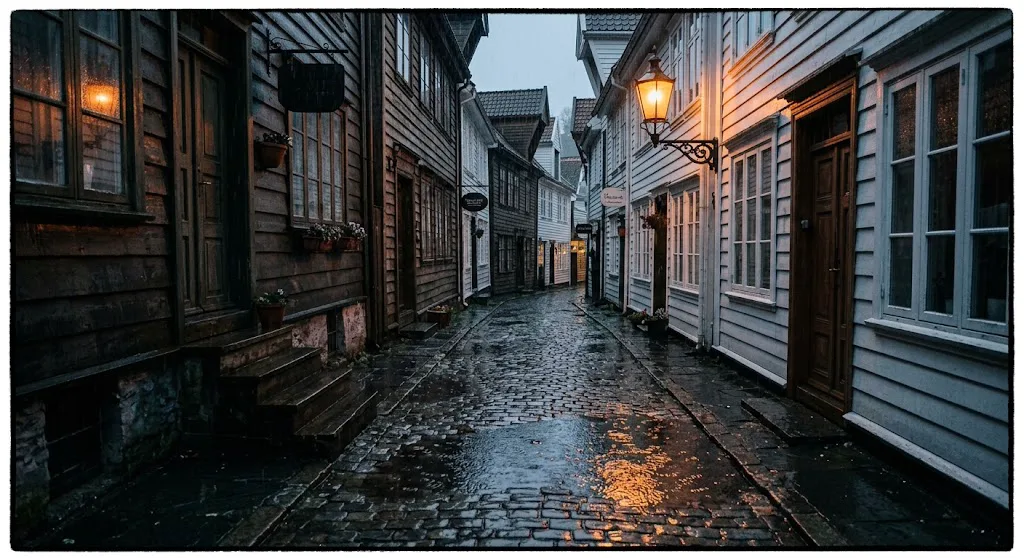
I. Bergen: La geografía de la lluvia perpetua y la humedad crónica
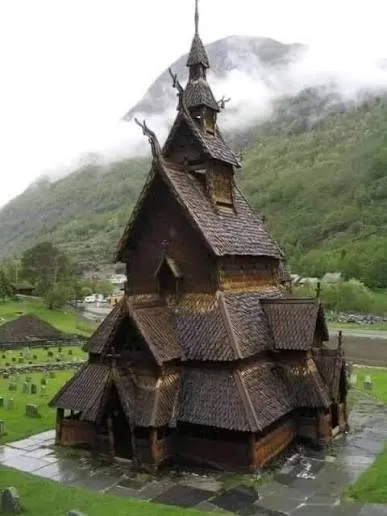
II. La acústica sacrílega: Las Stavkirke como catedrales del fuego
- La madera de pino curada durante siglos actúa como un resonador natural de frecuencias medias y bajas, otorgando una calidez y una reverberación envolvente, casi litúrgica.
- Los techos altos y abovedados en forma de pirámide escalonada generan un tiempo de reverberación (RT60) larguísimo, pensado originariamente para que los cantos gregorianos y corales resonaran con una solemnidad celestial sobrecogedora.
III. El estudio Grieghallen y Eirik «Pytten» Hundvin: La ingeniería de la intemperie
- Burzum – «Det som en gang var» (1993, Pytten / Deathlike Silence Productions): Grabado con un equipo minimalista y un amplificador minúsculo de baja potencia colocado al límite de su saturación en una habitación con paredes de piedra y madera. La reverberación natural de la sala compensaba la absoluta falta de medios de producción, creando una atmósfera claustrofóbica y lejana a la vez.
- Emperor – «In the Nightside Eclipse» (1994, Pytten / Candlelight Records): Un hito absoluto de la producción extrema. Pytten logró equilibrar la brutalidad del black metal tradicional con una espacialidad sinfónica monumental, utilizando los micrófonos ambientales (room mics) situados a gran distancia para captar el rebote del sonido en las paredes del estudio, simulando la inmensidad gélida de una catedral natural de hielo.
IV. La mutación tecnológica: De la madera al circuito impreso
La física del ruido: El pedal Boss HM-2 y la muerte de la fidelidad analógica
I. Anatomía de una anomalía: La circuitería del caos
II. Del Death Metal Sueco al viento polar noruego
- El Efecto de Ventisca Artificial: Al combinar el realce de agudos extremos del HM-2 con guitarras afinadas en estándares o ligeramente bajadas, el zumbido de abeja característica del pedal se fundía con el tremolo picking ultrarrápido. El resultado acústico simulaba a la perfección el sonido del viento racheado arrastrando cristales de hielo en una ventisca de alta montaña.
- La Anulación del Bajo Dinámico: El circuito del HM-2 comprime tanto las frecuencias intermedias que neutraliza la separación tradicional entre guitarras y bajo. El instrumento de seis cuerdas devora el espectro sonoro, creando una masa uniforme que imita la inmensidad opresiva de la naturaleza escandinava.

III. La muerte de la fidelidad: El manifiesto del Lo-Fi como declaración política
- El Arte de la Cinta Degenerada: Maquetas legendarias como las de Mayhem («Pure Fucking Armageddon»), los primeros ensayos de Burzum o los lanzamientos iniciales de Darkthrone fueron grabadas utilizando un único micrófono de ambiente conectado a una grabadora de casete de baja calidad. Cuando el oyente reproducía esa cinta en su reproductor portátil o la copiaba mediante el sistema de tape-trading, el medio magnético sufría una pérdida progresiva de fidelidad: el flutter del motor, la saturación de la cinta magnética (tape saturation) y el siseo de fondo (hiss) se convertían en capas adicionales de textura sónica.
- La Distorsión como Escudo Protector: Para una generación de jóvenes que despreciaba el mundo moderno, el lo-fi funcionaba como una alambrada invisible. La mala calidad de sonido servía como filtro cultural: si un oyente no era capaz de soportar la aspereza del ruido o de descifrar los riffs ocultos bajo capas de estática, significaba que no pertenecía al círculo íntimo de la iniciación underground. El ruido protegía el secreto.
IV. La ingeniería del aislamiento social
V. La paradoja del progreso tecnológico
La irreproducibilidad del mito: Por qué el Black Metal de los 90 no se puede clonar
I. La trampa del plugin: La paradoja de emular el caos analógico en Alta Definición
- El Error de la Perfección: Cuando un productor actual abre un software para «ensuciar» digitalmente una pista de guitarra limpia, está aplicando un algoritmo controlado. Sabe exactamente cuánta distorsión introduce, dónde corta los graves y qué nivel de ruido blanco de fondo (hiss) añade para simular antigüedad.
- La Incertidumbre Histórica: En 1992, la suciedad no era un adorno estético; era la consecuencia física ineludible de grabar con equipos rotos, cables defectuosos, cintas magnéticas gastadas y una absoluta ignorancia de la ingeniería de sonido tradicional. Esa incertidumbre material -el hecho de que la pista pudiera sonar diferente cada vez que rebobinabas la cinta- introducía un factor orgánico imposible de replicar mediante una interfaz gráfica de usuario.
II. La gentrificación del underground y la pérdida del aislamiento
III. El paisaje como Co-Autor: La ruptura ecológica
Epílogo: El eco permanente en los archivos de la historia
The land of granite and perpetual shadow (Geomorphology of Misanthropy)
Throughout my years at the editorial desk, one certainty has settled in my mind with the force of dogma: extreme music is not born in a vacuum. It is not the sole product of a mind touched by genius in a comfortable suburban room. Sometimes, geography pierces through your hands, seeps into your bones, and forces you to step on the distortion pedal in a very specific way.
When we listen to the opening bars of Darkthrone’s «A Blaze in the Northern Sky», or let ourselves be frozen by the production of Emperor’s «In the Nightside Eclipse», we are not merely listening to artistic choices made at a mixing console. We are listening to pure geology. We are hearing the vibration of Scandinavian granite, the dull echo of Norwegian fjords, and the crushing weight of a six-month night that tightens around your chest until you crave the burning of everything established.
Today at Atanathos, we brush the dust off the archives to sign a journalistic and sonic investigation essay into the topography of hatred. Welcome to the autopsy of the landscape that birthed the most dangerous, cold, and barren movement in the history of rock.
I. The tyranny of the precambrian shield: Granite as a soundboard
To understand why early nineties Norwegian black metal sounded like an icy stab and a gale-force wind, one must travel geologically long before Euronymous was born or the infamous Helvete circle was founded in Oslo. One must look at the Precambrian Shield –or Baltic Shield- that immense mass of igneous and metamorphic rock (primarily granite and gneiss) forming the backbone of the Scandinavian peninsula.
Physically and acoustically speaking, the geology of the terrain dictates how sound travels and how human communities interact with their sonic environment. Landscapes dominated by sedimentary plains of clay or sand absorb high frequencies, dampen sound, and return a warmer, rounder, and more contained acoustic response. Scandinavia is the exact opposite: a colossal desert of ancient stone, hard rock devoid of soft porosity.
In the deep valleys of the fjords, flanked by vertical walls of sheer rock towering over a thousand meters high, sound waves do not disperse; they bounce violently. The sound of thunder, the roar of a waterfall, or the crackle of a fir tree whipped by a gale becomes a metallic, natural, and shrill reverberation.
When those kids from Bergen, Oslo, or Sarpsborg picked up their electric guitars in the late eighties and decided that classic Florida death metal (with its clean Morrisound studio productions and sun-drenched palm trees) was too warm and commercial, their ears were already calibrated by that natural acoustics of granite. The razor-sharp distortion of black metal unconsciously yet infallibly mimics the way polar wind splinters when striking jagged rock faces. It is not an aesthetic coincidence; it is a mimetic response to the physical environment.
II. The polar night and light deprivation: Neurobiology of discontent
One cannot dissociate the acoustics of black metal from its meteorological and psychological context. In the northern regions of Norway, above the Arctic Circle, winter brings the polar night (mørketid) -a period lasting weeks or months where the sun simply does not rise above the horizon. Even further south, in Oslo or Bergen, winter days are reduced to a mere few hours of gray, diffused, ashen light that barely grazes the treetops before plunging the world into absolute darkness by three in the afternoon.
Studies in neurobiology and environmental psychiatry have documented for decades the devastating effects of prolonged light deprivation on the human brain:
Drastic suppression of vitamin D synthesis.
Chronic disruption in melatonin production (the sleep hormone).
Severe alteration of serotonin levels -the neurotransmitter responsible for regulating mood, calm, and emotional stability.
When you lock a group of misanthropic teenagers and young adults in dark, damp, poorly lit basements through a perpetual winter where outside temperatures hover between fifteen and thirty degrees below zero, the human brain undergoes a radical disconnection from conventional social reality.
This neurobiological alienation finds its direct outlet in musical composition. Bright harmonic structures, major progressions, and the festive tempos of traditional rock are perceived as an insulting offense against the crushing reality of the environment.
The light-deprived brain seeks chaos, speed, and coldness as a reflection of its own internal state. Hence, ultra-fast tremolo picking -those notes played on a single string at insane speeds with the plectrum- does not aim for virtuoso technical showmanship, but rather reproduces the physical sensation of hypothermic shivering combined with the anxious urgency to escape mental darkness. It is a constant pulse against the paralysis of the Nordic winter.
III. The aesthetics of emptiness: The density of silence in the Boreal Forest
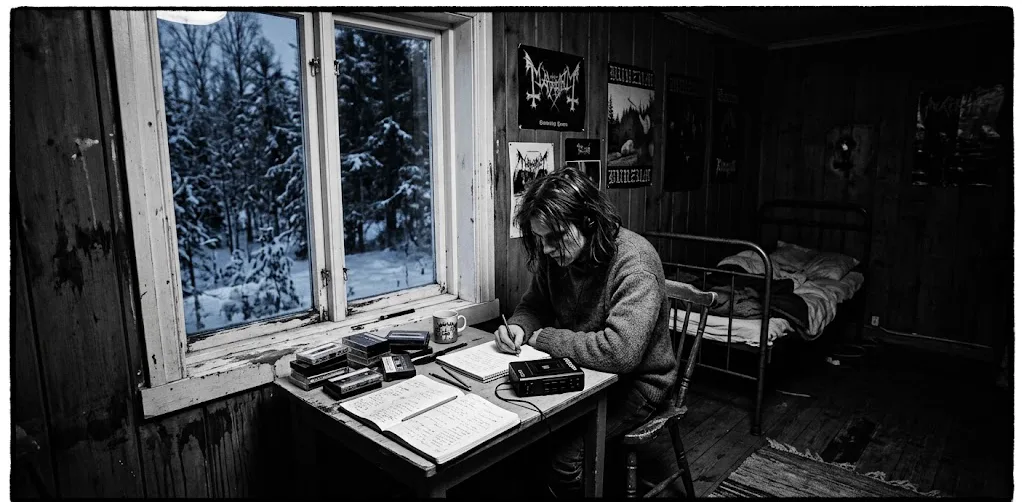
There is another fundamental topographic element that shaped the sound of this first and second wave of black metal: the boreal forest (taiga), dense, silent, and overwhelmingly solitary.
Anyone who has walked through the fir and pine forests of Scandinavia knows that sound there carries a very particular texture. The thick layer of moss, lichens, and fallen pine needles on the ground acts as a natural acoustic trap that absorbs low-frequency noises. The forest is a realm of almost religious silence, broken only by the dull wind through the treetops or the distant snapping of frozen wood.
This duality between the sepulchral silence of outer nature and the sharp, gut-wrenching human scream defines the genre’s compositional dynamics.
While death metal sought urban density, the smell of industrial sewers, and slaughterhouse butchery (reflecting the bustling cities of New York, Tampa, or Stockholm), black metal consciously fled civilization. It retreated into the forest. And in doing so, its sound adopted the texture of that environment: a razor-sharp wall of sound, distant, with guitars that sound like buzzsaws cutting through frozen air, floating over a backdrop of natural reverb that emulates the empty vastness of unpopulated valleys.
The Architecture of Fire and Moisture: Bergen Studios and the Ruins of the Stave Churches (Stavkirke)
If the granite of the Precambrian Shield laid the physical foundations and the polar night shaped the neurobiological imbalance that birthed black metal, the sound needed to find an enclosed space to amplify, distort, and acquire its true sacrilegious dimension. During the crucial years between 1991 and 1993, the Norwegian scene split geographically into two creative poles as distant in weather as they were inseparable in influence: the capital, Oslo, with its urban backdrop of dark alleys and underground shops, and Bergen, the capital of rain nestled on the rugged, rain-drenched western coast.
To understand why the West Coast sound -the epicenter of legendary bands like Immortal, Enslaved, and Gorgoroth- possessed a watery, cavernous texture soaked in a radically different ancient breath than that of Oslo, one must descend into the rehearsal basements of Bergen and examine the interplay between medieval wooden architecture and the brutality of Atlantic weather.
I. Bergen: The geography of perpetual rain and chronic humidity
Bergen is no ordinary city; it is a giant sponge trapped between seven mountains and relentlessly battered by North Sea currents. With over two hundred days of rainfall per year, the relative humidity in the air along the western Norwegian coast is a constant factor conditioning not only daily life, but the physical behavior of materials, instruments, and audio equipment.
In the damp, poorly ventilated rehearsal spaces where Bergen bands spent winters playing at criminal volumes, the wood of the amplifier cabs, potentiometers oxidized by salt spray and condensation, and guitars slipping out of intonation due to thermal swings created an environment of permanent material degradation. This degradation was not fought; it was embraced as part of the creative process.
Acoustically, air humidity alters the absorption of high frequencies. In an environment saturated with water vapor, extreme highs tend to attenuate slightly, forcing guitarists to max out the treble and distortion controls on their amplifiers (typically brands like Marshall or Peavey pushed to the point of collapse) to achieve that signature metallic wasp buzz that sliced through the mix like a razor blade. The resulting sound was far from pristine; it was a dense, thick, and damp wall of sound, perfectly synchronized with the landscape of perpetual drizzle burying the roofs of the Hanseatic city.
II. Sacrilegious acoustics: The Stavkirke as Cathedrals of Fire
No discussion on the topography of sound in Norwegian black metal would be complete without addressing the most macabre architectural and acoustic phenomenon in its history: the systematic burning of the stave churches (stavkirke).
Originally constructed between the 12th and 13th centuries, these medieval structures are unique architectural gems. Built entirely from high-density pine posts and beams fitted together without metal nails, they utilized joinery techniques inherited from Viking longship (drakkar) construction. From an acoustic engineering standpoint, the interior of a stavkirke is an organic marvel:
Pine wood cured over centuries acts as a natural resonator for low and mid frequencies, conferring a warm, enveloping, almost liturgical reverberation.
High, vaulted ceilings shaped like stepped pyramids generate an extremely long reverberation time (RT60), originally engineered to make Gregorian and choral chants resonate with overwhelming, heavenly solemnity.
When the most radical wing of the movement launched its incendiary crusade against institutional Christianity -destroying heritage gems such as the Fantoft church in Bergen or the Holmenkollen church in Oslo- the acoustics of these venues underwent a violent metamorphosis. The sacred interior, designed to foster respectful silence and prayer, turned into a massive pyre where the crackle of resinous wood burning at temperatures exceeding one thousand degrees produced an unrepeatable sonic uproar.
Although no musician recorded albums inside a burning church (for obvious reasons of survival), the destruction of these spaces marked an acoustic and symbolic liberation. The stavkirke represented order, an alien cultural imposition, and the Christian geometry that oppressed the territory’s pagan subconscious. Reducing them to ashes meant physically shattering the oppressor’s soundboard to reclaim the forest and the open elements as the only legitimate stages for extreme worship. The echo of those burning timbers remained floating in the genre’s collective imagination as the ultimate expression of a material and sonic catharsis.
III. Grieghallen Studio and Eirik «Pytten» Hundvin: Engineering the wilderness
If the churches provided the symbolic fire, the recording studio where the West Coast’s discographic totems were birthed supplied the professional engineering required to capture that chaos onto magnetic tape. We speak of Grieghallen Studios in Bergen, and its primary architect: Eirik «Pytten» Hundvin.
Unlike London or American studios, where engineers aimed for technical perfection, pristine instrument separation, and surgical cleanliness, Pytten immediately understood that black metal demanded a diametrically opposed approach. Working in a concert and recording hall with massive natural acoustics, the engineer knew how to capture the essence of the outdoor environment and translate it into the vinyl grooves.
Let us analyze the technical production specs of two masterpieces spawned at Grieghallen under Pytten’s direction:
Burzum – «Det som en gang var» (1993, Pytten / Deathlike Silence Productions): Recorded with minimal gear and a tiny, low-power amplifier pushed to the brink of saturation inside a room with stone and timber walls. The hall’s natural reverb offset the absolute lack of production resources, crafting an atmosphere that was simultaneously claustrophobic and distant.
Emperor – «In the Nightside Eclipse» (1994, Pytten / Candlelight Records): An absolute milestone in extreme production. Pytten managed to balance traditional black metal ferocity with monumental symphonic spatiality, using distant room mics to capture the sound bouncing off the studio walls, simulating the icy vastness of a natural ice cathedral.
In Pytten’s hands, the recording studio was no sterile laboratory, but an atmospheric compression chamber where the sensation of playing at midnight at the bottom of a frost-covered ravine was artificially recreated.
IV. Technological mutation: From timber to printed circuit board
We have seen how the geology of stone and the humidity of wood converged into an unrepeatable sound. However, for the sonic puzzle of Nordic black metal to be sealed forever in extreme music history, one last technological component was missing: the small red metal rectangle manufactured in Japan that forever transformed electric guitar distortion.
In the next section of this essay, we will dive into the electronic circuitry and physics of the Boss HM-2, the cursed pedal that turned a bee’s buzz into the official chainsaw of the Scandinavian apocalypse.
The physics of noise: The Boss HM-2 pedal and the death of analog fidelity
If granite geology sculpted black metal’s mental molds and Bergen’s humidity provided atmospheric density, the definitive transformation of that landscape into a pure electric wave required an artificial engineering component. Nature alone needed an electronic catalyst to completely shatter the traditional canons of high fidelity.
That catalyst was born neither in a Norwegian lab nor in a dark forest cabin, but on a Japanese industrial assembly line in the early nineteen-eighties. We speak of the infamous Boss HM-2 Heavy Metal distortion pedal, a black-and-orange device that, completely by accident, became Scandinavian extreme metal’s weapon of mass sonic destruction.
I. Anatomy of an anomaly: circuitry of chaos
Originally designed in 1983 by the Roland/Boss corporation to emulate the thick, massive sound of valve amplifiers stacked in arenas for commercial hard rock and heavy metal, the HM-2 utilized a saturation circuit based on transistors and germanium/silicon diodes with a unique feature: an active two-band EQ with a fixed boost in low-mid and high frequencies.
When extreme metal musicians in Sweden and Norway began experimenting with this pedal in the late eighties and early nineties, they discovered something extraordinary upon cranking every dial to its absolute limit -a technique known in underground jargon as the «All Knobs to Ten» setting.
From a sound physics perspective, pushing the pedal to this extreme causes brutal signal compression. The circuit stops acting as a dynamic filter and becomes a square wave rectifier. The peaks of the guitar’s sine waves are clipped drastically (extreme digital or analog clipping), generating a massive flood of odd harmonics. What emerges from the amp is no longer the clean musical note of a nickel string; it is a dense, harsh, uninterrupted wall of buzzing frequencies that instantly evokes the physical sound of a chainsaw cutting through fir logs.
II. From Swedish Death Metal to the norwegian polar wind
Although the Boss HM-2 pedal is foundationally associated with the Stockholm Death Metal sound (masterfully wielded by bands like Entombed on their iconic album «Left Hand Path» or Dismember on «Like an Everflowing Stream»), the Norwegian black metal scene appropriated this low-fidelity technology, adapting it to its own frigid aesthetic.
While in Stockholm the pedal was deployed to achieve a greasy, muddy, graveside heaviness, in the hands of northern pioneers it acquired a completely different atmospheric role:
The Artificial Blizzard Effect: By combining the HM-2’s extreme high-frequency boost with guitars in standard or slightly dropped tunings, the pedal’s signature buzzing merged with ultra-fast tremolo picking. The acoustic result perfectly simulated the sound of a gale-force wind driving ice crystals across a high-mountain blizzard.
Dynamic Bass Nullification: The HM-2 circuit compresses midrange frequencies so heavily that it neutralizes the traditional separation between guitar and bass. The six-string instrument devours the frequency spectrum, forging a uniform mass that mirrors the oppressive vastness of the Scandinavian wild.
III. The death of fidelity: The Lo-Fi manifesto as a political statement
In a record industry historically obsessed with cleanliness, instrumental clarity, and technical perfection -dominant paradigms in Los Angeles or London studios throughout the 1980s- the conscious decision to record with cheap gear, poorly calibrated cassette tapes, and amplifiers choked in distortion constituted an epistemological and political rupture.
Recording poorly was not the result of technical ignorance; it was a militant manifesto. It was a head-on rejection of the commercialization of music, studio capitalism, and the sterility of corporate sound.
The Art of Degenerate Tape: Legendary demos such as Mayhem’s «Pure Fucking Armageddon», Burzum’searliest rehearsal tapes, or the initial releases from Darkthrone were recorded using a single room microphone plugged into a low-quality cassette recorder. As the listener played that tape on a portable player or duplicated it through the tape-trading network, the magnetic medium suffered progressive fidelity loss: motor flutter, magnetic tape saturation, and background hiss transformed into additional layers of sonic texture.
Distortion as a Protective Shield: For a generation of youth who despised the modern world, lo-fi functioned as an invisible barbed-wire fence. Poor sound quality served as a cultural filter: if a listener could not endure the harshness of the noise or decipher the riffs buried beneath layers of static, it meant they did not belong to the inner circle of underground initiation. The noise protected the secret.
IV. The engineering of social isolation
Physically, this form of sonic production generated a phenomenon of perceptive isolation in the listener. Listening to a 1990s black metal record through low-quality headphones in a dark room demanded active cognitive effort. The brain had to actively reconstruct the melody from fragments of white noise and static comprising the mix.
That exertion alienated individuals from their everyday environment, plunging them into an introspective trance of misanthropy and urban disconnect. Analog noise technology fulfilled the exact same function as the geographical isolation of the fjords: severing the individual from the masses and returning them to the absolute solitude of their own mind.
V. The paradox of technological progress
We have analyzed how stone, water, timber, and printed circuit boards converged to birth a sonic monster impossible to replicate under conventional laboratory conditions.
Yet time moves forward, and today we face a fascinating paradox: What happens when 21st-century digital tools attempt to emulate the organic chaos of the nineties? In the fourth and final part of this essay, we will delve into the historical impossibility of cloning the myth and the trap of modern nostalgia.
The irreproducibility of myth: Why 90s Black Metal cannot be cloned
We have traversed an unusual physical and conceptual path: from the unyielding granite of the Precambrian Shield and the suffocating light deprivation of the polar night, through the sacrilegious acoustics of burning stavkirke and the perpetual dampness of Bergen basements, all the way to the geometric distortion of the Boss HM-2 pedal and the political militancy of lo-fi.
Throughout my years as an editor and witness to this scene, I have watched hundreds of contemporary bands attempt to recreate that mythical sound. They have bought identical vintage pedals, traveled to Norway to record in West Coast studios, and emulated the tempos of tremolo picking with surgical precision. And yet, something misses the mark. Something grates in the equation. The result sounds like an academic style exercise or a museum reenactment, lacking the razor-at-the-throat urgency that imbued the original 1992 or 1994 records.
Why is early nineties black metal historically irreproducible? The answer lies not in studio technique, but in the irreversible mutation of the modern world.
I. The plugin trap: The paradox of emulating analog chaos in high definition
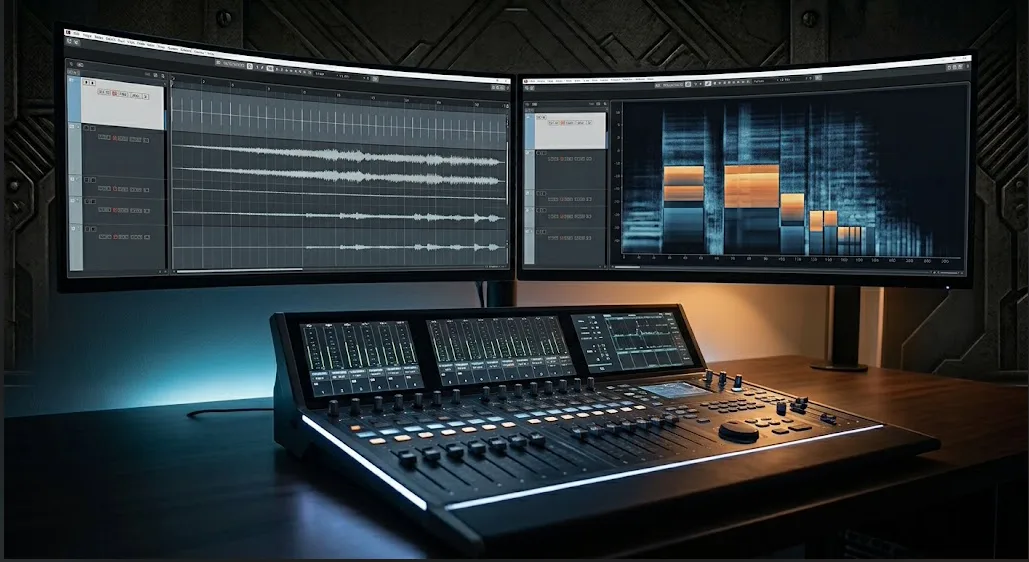
We live in the era of digital tyranny and bedroom studios. Today, any kid with a laptop in their bedroom can access entire plugin catalogs that mathematically simulate the exact saturation of a ninth-generation cassette tape, the thermal behavior of an eighties valve amp, or the frequency response of a cheap room mic.
Herein lies the grand technological paradox: the analog chaos of the nineties was not an audio effect added at will; it was collateral damage born of precarity.
The Error of Perfection: When a modern producer opens software to digitally «dirty up» a clean guitar track, they are applying a controlled algorithm. They know precisely how much distortion is introduced, where the low end is cut, and what level of background white noise (hiss) is added to simulate age.
Historical Uncertainty: In 1992, grit was not an aesthetic ornament; it was the inescapable physical consequence of recording with broken gear, faulty cables, worn magnetic tape, and complete ignorance of traditional sound engineering. That material uncertainty—the fact that the track could sound different every time you rewound the tape—introduced an organic variable impossible to replicate through a graphical user interface.
Attempting to clone lo-fi with high-end digital technology is like trying to recreate genuine war scars using cinematic makeup: the visual appearance might deceive at first glance, but the weight of pain and the authenticity of trauma are conspicuously absent.
II. The gentrification of the underground and the loss of isolation
The second major barrier to cloning the myth is the radical transformation of the planet in terms of connectivity, information, and cultural globalization.
In the early nineties, Scandinavia was, in sociological terms, isolated from the rest of the musical world. Information exchange relied on handwritten postal letters that took weeks to cross borders, photocopied black-and-white fanzines, and illicitly circulated cassette tapes. There were no instant internet forums, no YouTube tutorials on achieving the «perfect black metal guitar tone,» and no multinational corporations interested in monetizing the aesthetics of misanthropy.
Today, the underground has globalized and, in a way, gentrified. Bands belong to an instant global marketplace where everything is accessible with a single click. The geographical isolation that forced Norwegian musicians to look inward, lock themselves within their own mental obsessions, and forge an impenetrable cryptic language no longer exists. The global village has razed the forests of mystery.
III. The landscape as Co-Author: The ecological rupture
Finally, we must return to the starting point of this essay: topography.
The socioeconomic and ecological environment of modern Western Europe differs overwhelmingly from that of post-Cold War Norway. The climate crisis, the accelerated urbanization of the valleys, and the total connectivity of road networks have domesticated the land.
The suffocating isolation of the polar night is no longer experienced as a telluric curse from which one can only escape through extreme art; today, it is mitigated by massive artificial lighting grids, efficient central heating systems, and the constant distraction of digital hyperconnection. The human brain no longer suffers the abyss of light deprivation in the same manner, because the virtual world provides an immediate escape valve that eliminates the need to breed sonic monsters to exorcise the environment’s demons.
Deprived of its geographical co-author—the raw granite, the freezing fjord winds, the sepulchral silence of the boreal forest, and the corrosive dampness of the West Coast—contemporary black metal inevitably becomes a consumer cultural product: a musical genre encoded with neatly defined stylistic norms that can be studied in a conservatory or mimicked in a sound design suite.
Epilogue: The permanent echo in the historical archives
Closing this essay for the Atanathos archives leaves us with an inescapable conclusion. Nineties Nordic black metal was not merely a musical movement; it was an unrepeatable historical and geological anomaly.
It was the precise point in time when the ancient Precambrian Shield stone, the blind fury of the polar night, the purifying fire of medieval stavkirke, and the analog distortion of a Japanese pedal collided at a critical nexus of space and time. No amount of money, no state-of-the-art studio, and no contemporary band can ever return to us the damp scent of those Bergen basements or the biting cold of a cassette tape recorded at minus thirty degrees.
That is why we continually return to those worn records, with their photocopied sleeve art and sound saturated to the brink of exhaustion. Because when we drop the needle on our stereos, we are not merely listening to music; we are opening an archaeological window into a world that no longer exists -an untamed territory where geography and human hatred aligned to forge, for one singular moment in human history, the perfect soundtrack to the end of the world.